
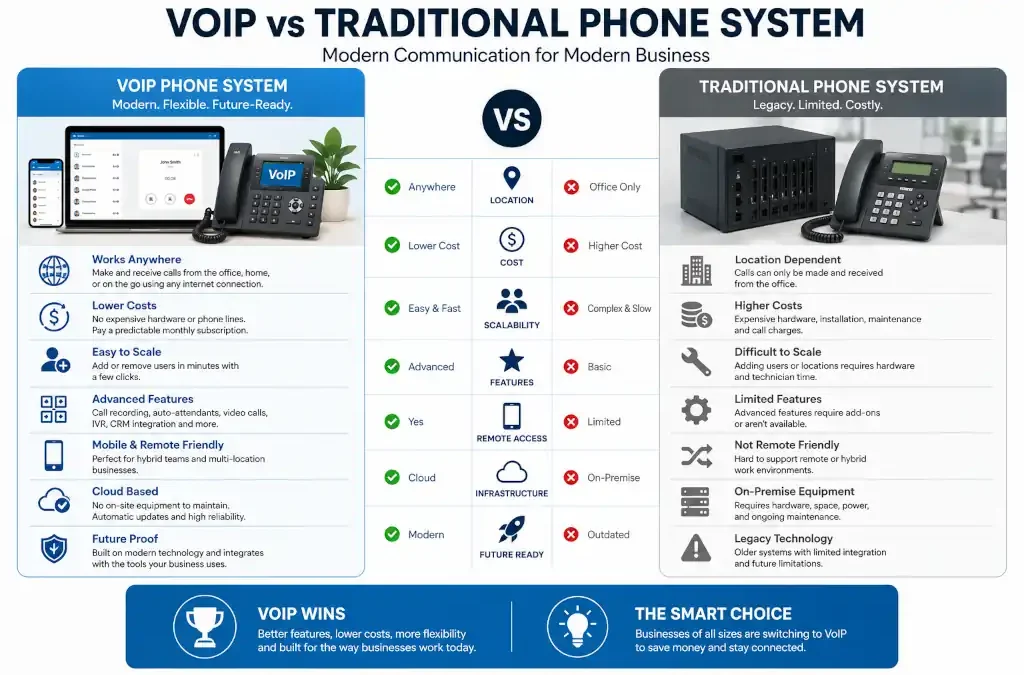
The classic comparison post — high search volume, commercial intent, and a clear path to XiTech's VoIP installation service. Written to help business owners make the decision, not confuse them.
01 — What is VoIP and how does it differ from a landline?
VoIP (Voice over Internet Protocol) is a phone system that runs over your internet connection instead of old copper phone lines.
Traditional landlines rely on physical PSTN infrastructure. VoIP converts voice into digital data and routes calls through the internet.
Traditional Landline
-
- Fixed to one location
- Requires physical phone cabling
- Expensive to scale
- Limited features
- Separate phone and internet infrastructure
- Telstra copper network dependency (largely being phased out)
VoIP
-
- Works anywhere with internet
- Use desk phones, mobiles, laptops, or apps
- Easy to add users and locations
- Advanced business features included
- Cloud managed
- Designed for hybrid work and modern businesses
For most businesses in 2026, VoIP is no longer “new technology.” It is now the default business communication platform.
02 — Cost comparison: upfront vs ongoing for each option
Traditional Phone System Costs
Typical costs include:
-
- PBX hardware
- Phone line installation
- Technician labour
- Ongoing line rental
- Maintenance contracts
- Expansion hardware
- Separate call costs
A small business can easily spend thousands upfront before making the first call.
VoIP Costs
VoIP dramatically reduces infrastructure costs.
Typical setup:
-
- Internet connection
- IP handsets or softphones
- Cloud PBX subscription
Example Comparison
| Feature | Traditional PBX | VoIP |
|---|---|---|
| Upfront Hardware | High | Low |
| Installation | Complex | Fast |
| Adding Users | Expensive | Simple |
| Remote Work | Difficult | Native |
| Maintenance | Ongoing | Minimal |
| Scalability | Limited | Easy |
| Call Features | Add-ons | Usually included |
Most Brisbane businesses moving to VoIP reduce communications costs while gaining significantly more functionality.
03 — Flexibility and remote work — where VoIP wins
This is where VoIP completely dominates traditional systems.
With VoIP:
-
- Staff can answer office calls from mobile phones
- Teams can work from home seamlessly
- Multiple offices operate under one phone system
- Calls can transfer anywhere instantly
- Business numbers remain consistent regardless of location
A modern business no longer needs to tie communication to a physical office.
For industries like:
-
- Real estate
- Construction
- Medical
- Professional services
- Retail
- Managed IT services
…VoIP gives operational flexibility traditional systems simply cannot match.
A Brisbane employee can answer a company call from the Gold Coast, Sydney, or overseas without the customer noticing any difference.
04 — Call quality and reliability in 2026
One of the biggest myths about VoIP is that it has poor quality.
That was true 10–15 years ago.
In 2026:
-
- Fibre internet
- Enterprise NBN
- SD-WAN
- QoS traffic prioritisation
- 4G/5G failover
- Cloud redundancy
…have made modern VoIP systems extremely reliable.
In many cases, VoIP call quality is now better than legacy phone systems.
Reliability Improvements
Modern systems include:
-
- Automatic failover
- Multi-device ringing
- Cloud redundancy
- Geographic redundancy
- Disaster recovery routing
If an office loses power or internet, calls can instantly reroute to mobiles or another location.
Traditional landlines cannot compete with that flexibility.
05 — What you lose when you switch (and why it usually doesn't matter)
There are a few things businesses give up when leaving traditional phone systems.
1. Physical Copper Line Reliability
Old copper lines could sometimes stay active during power outages.
But:
-
- Australia is shutting down legacy copper services
- Most businesses already rely heavily on internet infrastructure anyway
- Modern VoIP failover solves this better
2. Simplicity
Very old systems were simple:
-
- Pick up handset
- Make call
But modern businesses need:
-
- Call recording
- Mobile apps
- CRM integration
- IVRs
- Remote access
- Analytics
Traditional systems become limiting very quickly.
3. Fax Compatibility
Some legacy fax systems struggle over VoIP.
In reality:
-
- Most businesses barely use fax anymore
- Digital document workflows replaced it years ago
For most companies, the trade-off is overwhelmingly worth it.
06 — When a traditional system still makes sense
Traditional systems still fit some scenarios.
Examples:
-
- Remote rural sites with unstable internet
- Critical analogue devices
- Elevator phones
- Emergency analogue lines
- Legacy industrial systems
- Older medical or security infrastructure
Some businesses also keep:
-
- One analogue backup line
- Hybrid PBX systems
- LTE backup solutions
The reality:
Most businesses do not need a fully traditional phone system anymore — but some still benefit from partial legacy integration.
07 — How XiTech handles VoIP migrations across Brisbane and Gold Coast
XiTechhelps businesses migrate from outdated phone systems to modern cloud VoIP platforms with minimal downtime.
Typical migration process:
-
- Audit existing phone setup
- Review internet capability
- Port existing business numbers
- Configure cloud PBX
- Deploy handsets and apps
- Test failover and call routing
- Train staff
- Go live with staged migration
Key areas XiTech focuses on:
-
- Business continuity
- Number porting
- Remote workforce enablement
- Call flow optimisation
- Multi-site integration
- 4G/5G backup
- Cybersecurity considerations
- Ongoing local support
XiTech supports businesses across:
-
- Brisbane
- Gold Coast
- Regional Queensland
A properly planned migration usually takes far less time than businesses expect.
08 — One thing most VoIP guides skip — phonebook sync
Most VoIP articles focus on:
-
- call quality
- pricing
- features
- apps
…but skip one of the most useful business productivity features:
Syncory Phonebook Sync
Syncoryallows centralised phonebook synchronisation across supported VoIP handsets and systems.
That means:
-
- Staff always see updated contacts
- Shared business directories stay consistent
- New employees sync automatically
- Caller ID becomes more useful
- Admin management becomes far easier
Without phonebook sync:
-
- Staff manually maintain contacts
- Internal directories become outdated
- Businesses lose consistency across devices
For growing businesses, this becomes a hidden operational problem surprisingly fast.
A properly managed VoIP deployment should include:
-
- central directory management
- handset provisioning
- user synchronisation
- company-wide contact consistency
That is one of the overlooked differences between a basic VoIP setup and a professionally managed business communication platform.